
If you’re sourcing magnets for EV traction motors, industrial motors, robotics, or wind turbines, you’ve probably already run into the term “GBD” — Grain Boundary Diffusion.
Most people’s understanding of it stops halfway: “It’s basically coating Dy/Tb onto the magnet’s surface and heating it.” That’s not wrong, but it misses the part that actually matters.
What GBD really solves isn’t “whether to add heavy rare earth elements.” It’s this:
How do you get expensive heavy rare earth elements to show up only where the magnet actually needs them?
This comes down to a fairly elegant piece of materials engineering, and it’s worth understanding — especially if you’re going to be discussing GBD magnet specs with a supplier.
Heat Is the Real Enemy of NdFeB
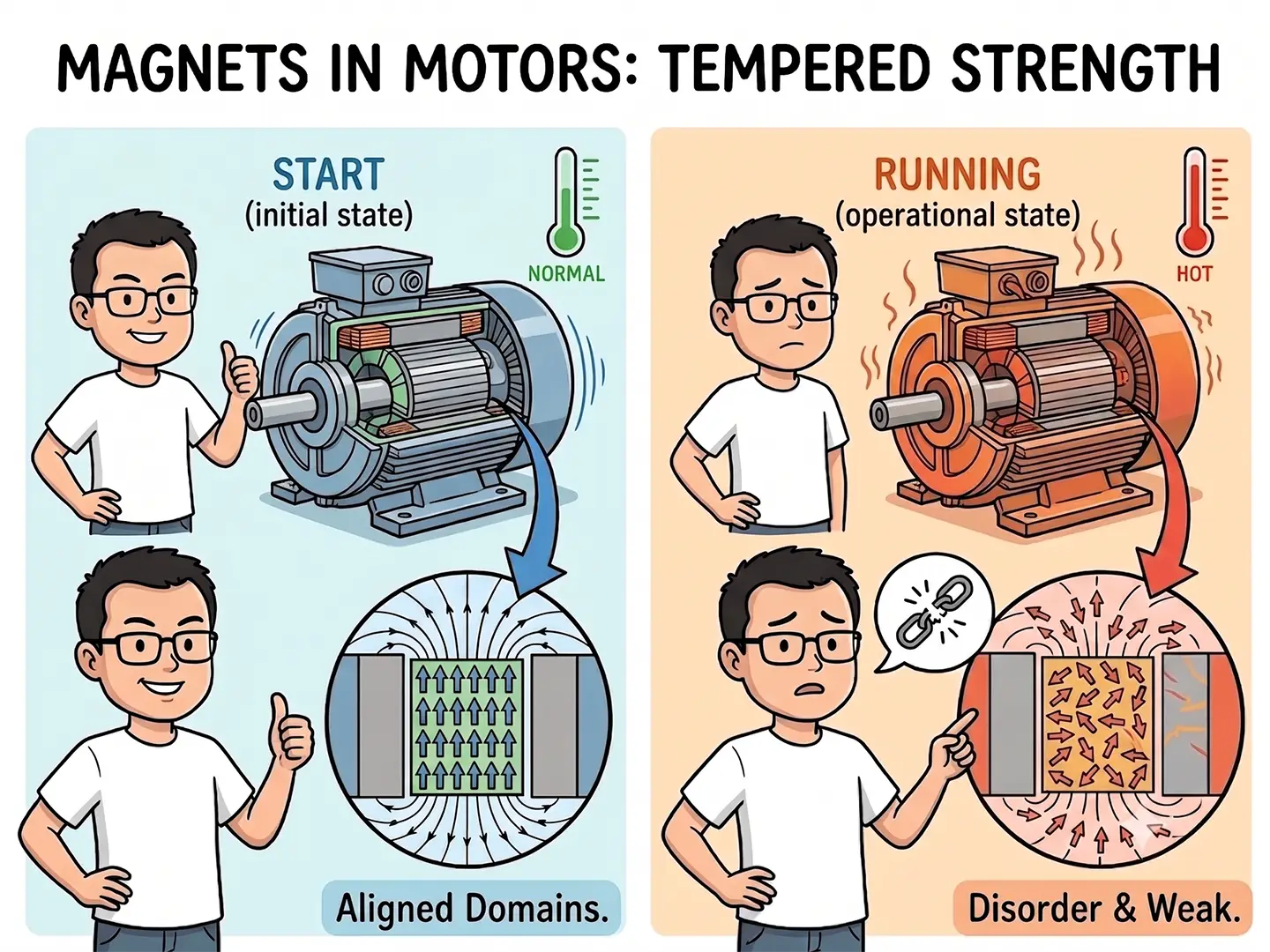
NdFeB magnets are known for high energy product, but they share a common weakness: as temperature rises, magnetic performance drops, and under the wrong conditions demagnetization can become irreversible.
That’s why a single magnetic grade branches into a whole family: N35, N35M, N35H, N35SH, N35UH, N35EH, N35AH. The energy product stays roughly the same across the series — what changes is coercivity (Hcj), which determines how much operating temperature the magnet can handle and how well it resists demagnetization. Generally, the further down the suffix list, the higher the temperature rating.
For EV traction motors and high-speed industrial motors, internal operating temperatures often exceed 100°C. At that point, the engineer’s real question isn’t “how strong is this magnet,” but “will it hold up under high temperature, a complex field environment, and long-term operation.” Coercivity is the number that answers that question.
Why Adding More Dy/Tb Isn’t the Obvious Win It Looks Like
Dysprosium (Dy) and terbium (Tb) are the heavy rare earth elements most effective at boosting coercivity. The logic seems simple: add more, get higher coercivity.
But there’s a cost. Once heavy rare earth elements enter the main phase throughout the magnet, they tend to pull down remanence (Br) — so you’re trading magnetic strength for heat resistance. And Dy/Tb are expensive and supply-constrained to begin with. In other words, “just add more” means paying twice: once in magnetic output, once in material cost — and the exchange rate isn’t great.
So the real question becomes: can heavy rare earth be concentrated only where it actually influences coercivity, instead of being distributed evenly through the whole magnet?
That’s exactly the problem GBD is built to solve.
Picture the Magnet as a Small City
The fastest way to understand GBD is to understand what a magnet actually looks like at the microstructure level.
A magnet that looks smooth and uniform to the eye is, under a microscope, made up of countless tiny grains. Think of each grain as a building, and the grain boundaries — the interfaces between them — as the roads connecting those buildings.
Demagnetization rarely brings down an entire “building” at once. It tends to start at grain surfaces and grain boundaries — the weak connection points. Which means: instead of reinforcing every building in the city, you get more out of reinforcing the connections that actually matter.
That’s the core idea behind GBD.
What GBD Actually Does
The process itself isn’t mysterious. It generally goes like this:
Start with a magnet made through the standard sintering process — alloying, powder milling, pressing, sintering, heat treatment, machining. The magnet already has its full microstructure at this stage.
Next, a diffusion source containing Dy, Tb, or other heavy rare earth elements is applied to the magnet’s surface.
Then comes the key step: the magnet goes through heat treatment under specific temperature and atmosphere conditions, during which the heavy rare earth elements begin migrating inward.
Crucially, this isn’t uniform penetration like ink soaking into paper. The diffusion preferentially travels along grain boundary channels and accumulates around the grain peripheries, forming heavy-rare-earth-enriched zones concentrated near the boundaries.
The result is a magnet with a clear gradient from surface to core: the near-surface region shows a stronger heavy rare earth effect, which tapers off toward the center. This isn’t just “adding material” — it’s a redesign of the magnet’s microstructure.
Where the Efficiency Comes From — and Where the Limits Are
This is why GBD can deliver coercivity gains comparable to (or better than) conventional bulk-alloying approaches while using significantly less heavy rare earth — and why it’s gained traction in high-performance motor applications.
But because diffusion moves inward from the surface, the magnet’s thickness, geometry, surface-area-to-volume ratio, grain boundary structure, base alloy composition, and process parameters all jointly determine whether the diffusion actually reaches the core. There’s no universal GBD recipe that works across every size and grade. Thicker magnets place higher demands on the diffusion process, and certain geometries require diffusion paths designed specifically for them.
So GBD isn’t a plug-and-play upgrade. It’s closer to a process that needs to be engineered around the specific part, not a standard step you drop into any production line.
Three Things Buyers Often Overlook
These are the areas where engineering and procurement teams most commonly get tripped up:
Post-processing needs to be planned in advance. GBD’s reinforcement effect is concentrated near the surface. If a magnet undergoes significant grinding, cutting, or dimensional rework after diffusion, part of the effective diffusion layer can be removed — leaving you with perfect final dimensions but magnetic performance that no longer matches the design. The better approach is to plan machining allowance and diffusion design together from the start.
Surface treatment needs to be validated for GBD material specifically. GBD can change the surface composition and microstructure of the magnet, so a plating or corrosion-protection process that’s been validated on a standard grade doesn’t automatically transfer to a GBD magnet. If a supplier says “we treat it the same as regular magnets,” that’s worth a follow-up question.
Lead times typically extend, but by how much depends on the specifics. Diffusion and its accompanying heat treatment are additional process steps requiring control over temperature, atmosphere, and time. How much this extends the production cycle depends on magnet size, grade, diffusion approach, quantity, and post-processing requirements — there’s no one-size-fits-all number of extra days. The safer approach is to flag GBD requirements early in the project, rather than raising it after standard magnets have already been machined.
Where GBD Actually Makes Sense
If an application doesn’t demand high operating temperatures or high coercivity, and cost sensitivity is the priority, GBD may not be the right call — it solves a specific problem, not a universal upgrade.
But where high magnetic performance, thermal stability, and efficient heavy rare earth usage all matter simultaneously, GBD becomes attractive:
– EV traction motors — high power density combined with high operating temperature demands strict control over demagnetization risk
– High-speed industrial motors — higher rotational speeds raise the stakes on thermal management and magnetic stability
– Robotics joint motors — limited space requires higher power density per volume
– Wind turbine generators — long service life means performance degradation carries a high maintenance cost
What to Actually Ask a Supplier When Sourcing GBD Magnets
A more useful line of questioning than “do you offer GBD” looks like this:
1. Which base grade family is this GBD process developed for?
2. Given my part’s size and geometry, will diffusion actually reach the region I need reinforced?
3. What’s the resulting Hcj after GBD, and how does it perform at my actual operating temperature?
4. Has high-temperature demagnetization testing been done for this operating condition?
5. If further machining is needed downstream, how are machining allowance and diffusion design coordinated?
6. Has the surface treatment process been separately validated for GBD material?
Underneath all six questions is the same point: GBD isn’t an isolated surface treatment step — it’s a system that has to be engineered together with the magnet’s size, grade, machining, and surface finish.
—
The Bottom Line
If you had to summarize the difference between GBD and conventional approaches in one sentence: conventional processing adds heavy rare earth throughout the entire magnet; GBD adds it only where the magnet needs it most. The difference sounds small, but it represents a fundamentally different logic for how expensive material gets used.
For motor customers, what you actually need was never “a magnet with high Dy content.” It’s a magnet that performs reliably, long-term, at your operating temperature and field conditions. GBD matters because it offers a more precise way to get there.
At Oceanic Magnet, we believe choosing a GBD magnet shouldn’t start and end with a grade name.Operating temperature, demagnetization field, Hcj requirements, magnet geometry, machining allowance, and surface treatment plan all deserve to be part of the conversation early in the project. A good GBD solution isn’t just “yes, we can do GBD” — it’s an explanation of why you need it, how it should be engineered, and what should be validated at the end.