When selecting sintered NdFeB permanent magnets for electric motors or precision actuators, design engineers routinely specify standard grade labels based on ambient temperature magnetic properties.
A material grade defines the magnetic properties measured under standardized conditions. It does not automatically define irreversible thermal stability under a specific operating environment.
According to standard material datasheets, a typical 42SH grade magnet is certified under 20° ambient conditions with the following baseline parameters:
| Parameter | Symbol | Min Value | Max Value |
| Remanence | Br | 12.9 | 13.4 |
| Coercivity | Hcb | 12.2 | – |
| Intrinsic Coercivity | Hcj | 20.0 | – |
| Max Energy Product | (BH)max | 40.0 | 44.0 |
On paper, any magnet meeting these metrics qualifies legally as 42SH. However, in field applications—particularly electric motor rotors operating continuously between 90°C and 100°C—engineers frequently encounter an unsettling phenomenon: two 42SH magnets sourced from different manufacturers exhibit drastically different flux loss and torque degradation.
Why does this happen? The answer lies in a critical procurement gap: the lack of an explicitly contractual High-Temperature Irreversible Loss specification.
Reversible Loss vs. Irreversible Demagnetization
To understand why 42SH magnets diverge at elevated temperatures, we must differentiate between two types of thermal loss:
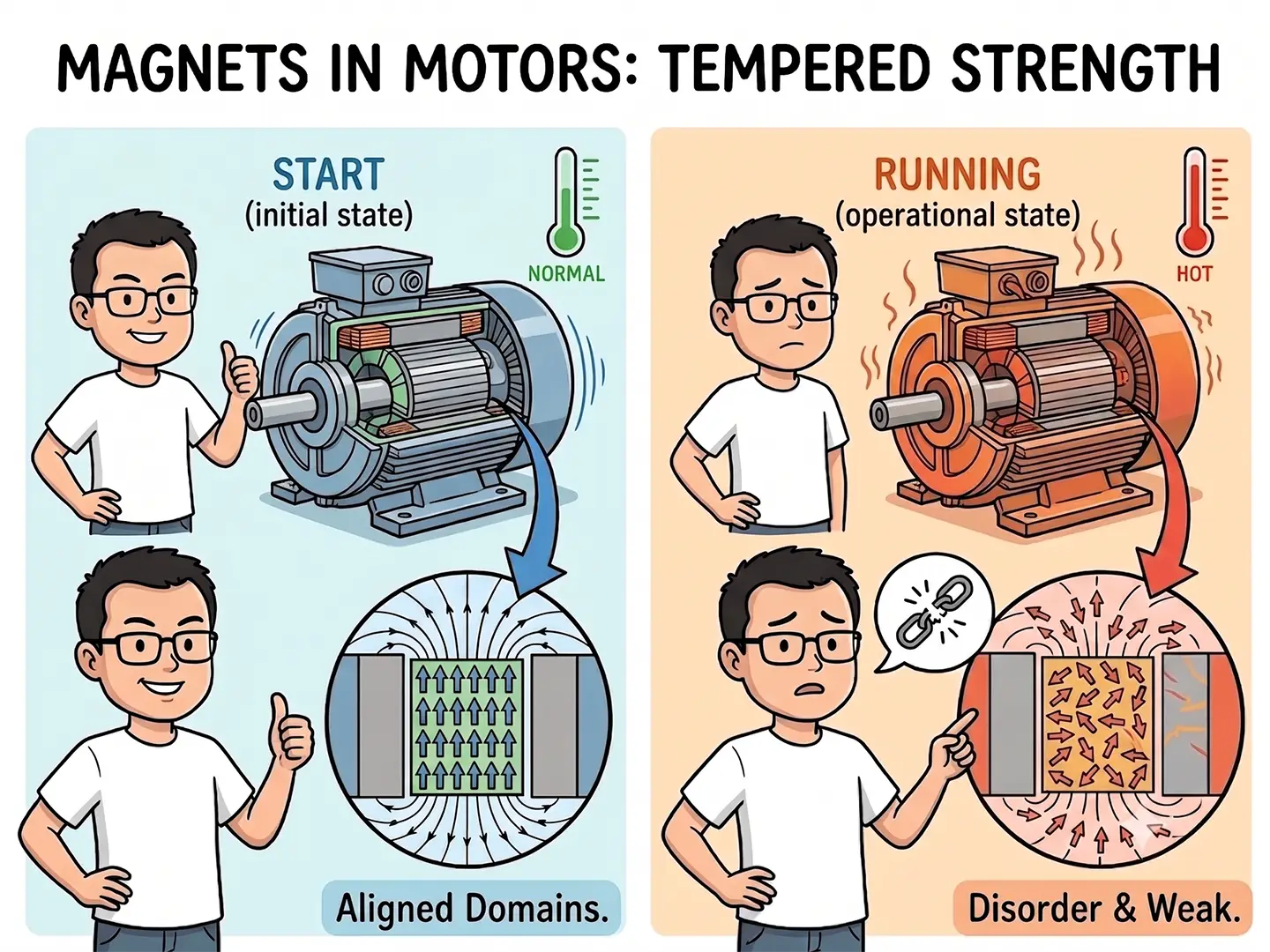
- Reversible Loss: Driven by temperature coefficients. As the temperature rises to 100°C, magnetic flux drops naturally, but it fully recovers once the magnet cools back down to 20°C.
- Irreversible Loss (h_irr): Caused when elevated operating temperatures shift the knee point of the second-quadrant B-H demagnetization curve above the working permeance point (Pc). Once cooled back to ambient temperature, this portion of lost flux is permanently gone unless re-magnetized.
If a buyer simply orders 42SH without defining an explicit thermal demagnetization limit (for example: Max 3% irreversible loss after 2 hours at 100°C), the manufacturer is legally permitted to supply a magnet optimized strictly for 20°C compliance.
The Hidden Cost Component: Dysprosium (Dy) & Terbium (Tb) Optimization
Achieving high thermal stability requires precise metallurgical control. To push the second-quadrant B-H curve’s knee point further away from the operating point at 100°C, manufacturers must fortify the magnet’s crystal lattice anisotropy field.
This is accomplished by adding Heavy Rare Earth elements—specifically Dysprosium (Dy) or Terbium (Tb)—either through bulk liquid-phase alloying or advanced Grain Boundary Diffusion (GBD) technology.
- Standard 42SH (Unspecified Thermal Loss): Formulated with minimal Heavy Rare Earths to barely satisfy Hcj >= 20.0 kOe at 20°C. Raw material cost is lower, but high-temp irreversible loss can easily exceed 8% to 10%.
- Engineered 42SH (Guaranteed <= 3% Loss at 100°C): Formulated with elevated Dy/Tb concentration at critical grain boundaries. This prevents domain wall nucleation at elevated thermal states, keeping irreversible loss well below 3%.
Because Dy and Tb are significantly more expensive than base Neodymium (Nd), two 42SH magnets with identical room-temperature datasheets may result in a noticeable increase in material cost.
The 3 Testing Conditions for High-Temperature Loss
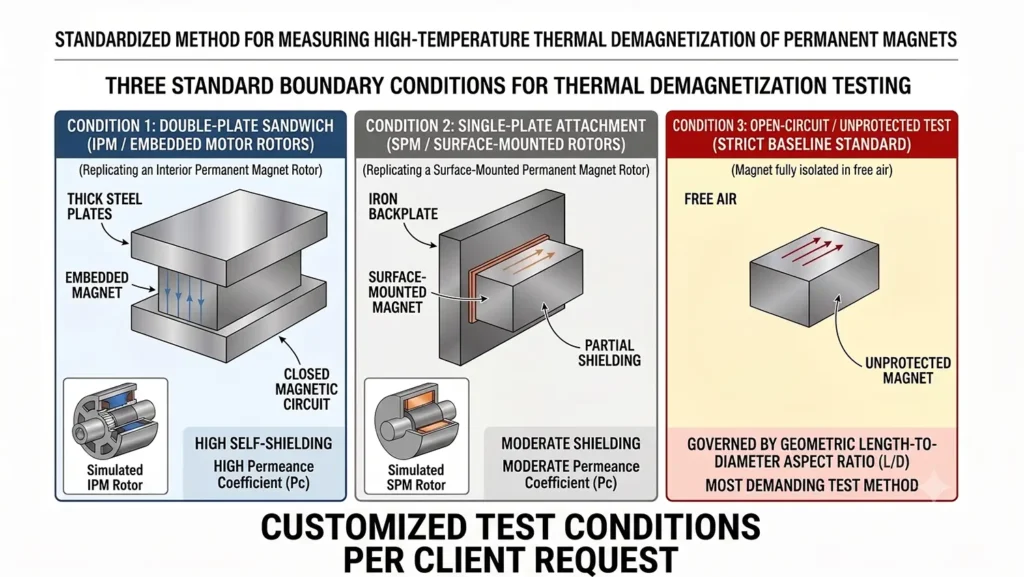
When specifying an irreversible loss limit, engineers must align the test protocol with the magnet’s physical operating environment. The working permeance coefficient (Pc) changes drastically depending on how the magnet is shielded by iron backplates.
There are three standard boundary conditions for measuring high-temperature thermal demagnetization:
- Condition 1: Double-Plate Sandwich (IPM / Embedded Motor Rotors)
The magnet is clamped between two steel plates, replicating an Interior Permanent Magnet (IPM) rotor. The closed magnetic circuit raises Pc, offering high self-shielding against thermal demagnetization. - Condition 2: Single-Plate Attachment (SPM / Surface-Mounted Rotors)
The magnet is bonded to a single iron backplate, mimicking Surface Permanent Magnet (SPM) architecture. Pc is moderate. - Condition 3: Open-Circuit / Unprotected Test (Strict Baseline Standard)
The magnet stands completely isolated in free air without steel shielding. Pc is governed strictly by the magnet’s geometric length-to-diameter aspect ratio. This is the most demanding test method.
Standardized Test Protocol (SOP)
To establish a verifiable acceptance standard with your magnet manufacturer, implement the following 5-step testing procedure:
- Initial Ambient Measurement (Phi 1): Measure the open-circuit total magnetic flux (Phi 1) of the fully magnetized sample at 20°C using a calibrated Helmholtz Coil and Fluxmeter.
- Boundary Setup: Place the sample into the agreed physical condition (Double-Plate, Single-Plate, or Open-Circuit).
- Thermal Soaking: Heat the assembly in a thermal chamber at the specified operating temperature (for example, 100°C) for 2 hours to reach complete thermal equilibrium.
- Cool-Down: Remove the sample and allow it to cool back to ambient temperature (20°C) naturally.
- Final Measurement (Phi 2): Re-measure the open-circuit flux (Phi 2) at 20°C using the same Helmholtz Coil.
Calculate the Irreversible Loss Rate (h_irr) using the following formula:
Irreversible Loss Rate = [ ( Phi 1 – Phi 2 ) / Phi 1 ] x 100%
Conclusion: How to Specify Magnets Correctly
A room-temperature grade label like 42SH is a baseline starting point, not a complete engineering contract. To eliminate field failures, reduce total system cost, and ensure true apples-to-apples vendor comparisons:
- Define Your Operating Temperature: State both the continuous working temperature and peak short-term thermal spikes.
- Establish the Irreversible Loss Threshold: Explicitly define the maximum allowed irreversible flux loss (for example: Max 3% loss after 2 hours at 100°C).
- Specify the Test Boundary Condition: Clarify whether testing must be performed under Open-Circuit, Single-Plate, or Double-Plate conditions.
By establishing thermal demagnetization parameters upfront, you empower magnetics engineers to optimize Dy/Tb grain boundary diffusion precisely for your application—delivering maximum reliability without paying for unnecessary over-engineering.


